

The administration app for clubs, groups, teams, and associations.
Get started now

.webp)


Effective financial management is crucial for the long-term success of your club. It enables transparent oversight, efficient use of resources, and strengthens member trust.
Just in time for the 2025 year-end and the start of 2026, we have recorded a webinar covering all the relevant features for managing finances and membership fees.
As a treasurer, financial officer, or auditor in a club, you play a crucial role in managing its finances. Whether it is a music club, sports club, cultural club, or recreational group, effective financial management is essential for the long-term success and sustainability of the club.
In this blog post, we will share some proven tips and best practices for managing club finances to ensure your club remains financially healthy.

The treasurer is responsible for the club's daily financial transactions, such as deposits and withdrawals, and manages the bookkeeping. The financial officer supports the board in financial matters, preparing budgets and financial reports.
The auditor regularly reviews the club's financial records to ensure their accuracy and compliance. Together, they play a crucial role in ensuring proper financial management and control within the club.
In practice, the first two roles can sometimes be combined. The auditor, however, is always a separate person who is not part of the board.
You can find more information on bookkeeping for clubs in the following article – club bookkeeping.
Managing a club's finances requires diligence and planning. From clear bookkeeping to working with experts – here are five key aspects that every treasurer or financial officer should keep in mind to ensure the financial health of the club:
Clear and transparent bookkeeping is the foundation of any successful financial management. As a treasurer or financial officer, you should ensure that all of the club's financial transactions are carefully documented. Ideally, use accounting software or at least a structured spreadsheet for this purpose.
Keep all receipts and documents and ensure they are easily accessible. This builds trust with members and facilitates the work of the auditors.
Creating and regularly updating a budget is essential for effective financial management. Take the time to create realistic estimates for income and expenses, including membership fees, donations, event revenue, equipment costs, rent, and other expenditures. A well-thought-out budget allows you to define your financial goals and ensure that the club stays on track financially.
The timely collection of membership fees is crucial for a club's financial stability. Ensure that members are informed about payment methods and adhere to clear guidelines for fee collection. Furthermore, fundraising activities can be an important source of income for the club. Organize events such as benefit concerts, raffles, or sponsored runs to generate additional funds and engage the community.
Effective financial management also includes controlling expenses. Regularly review your spending and look for opportunities to optimize costs. This can include purchasing materials at discounted prices, using community spaces instead of expensive rentals, or negotiating better contracts with suppliers. By critically analyzing your expenses, you can ensure that your club operates in a financially efficient manner.
It is advisable to work with professional advisors to ensure that your club meets all legal requirements and minimizes financial risks. Accountants, tax advisors, and other financial experts can provide valuable insights and help you optimize your club's financial management. Ensure that you have regular audits conducted by independent auditors to guarantee the integrity of your financial data.
Effective financial management is crucial for the long-term success of any club, regardless of its type or size. By implementing clear bookkeeping practices, creating a budget, optimizing membership fees and fundraising activities, controlling expenses, and working with experts, you can ensure that your club remains financially healthy and successfully fulfills its mission.
The following article provides a comprehensive overview of financial auditing for clubs in Austria: financial auditing for clubs in Austria.
Stay on top of your finances with ease
With Vereinsplaner, we want to make managing your finances as simple as possible. Our financial tool covers club accounting, invoicing, donation management, and one-click financial reports, significantly reducing administrative work and errors. This allows you to focus on your club's core purpose and leadership. Learn more about financial management for clubs.
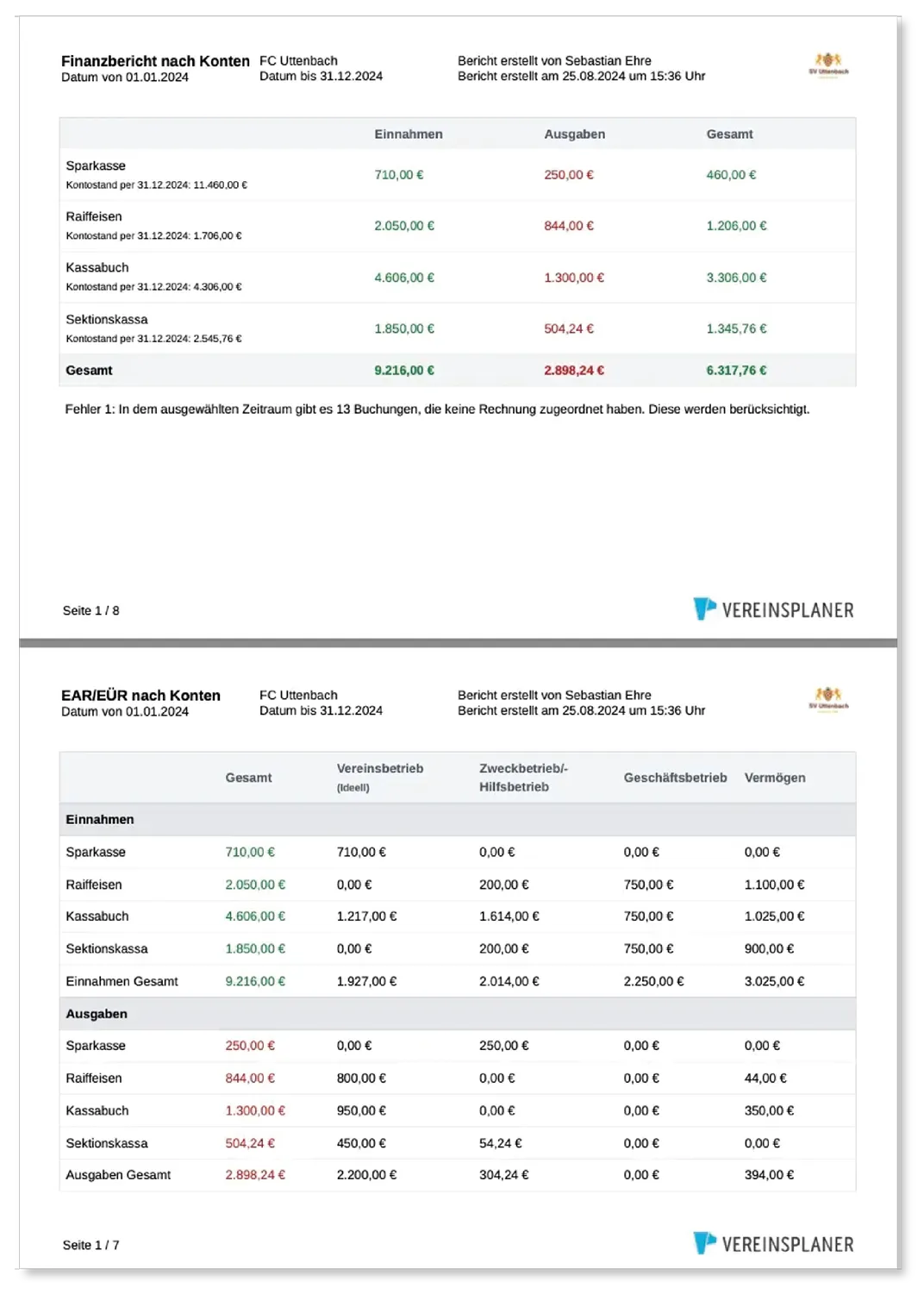
With Vereinsplaner, you can generate and export 9 different financial reports with a single click. Save valuable time and avoid unnecessary errors.
Define your club's financial goals and set realistic budgets to support them.
Identify competent individuals or a finance team responsible for managing finances who possess the necessary expertise.
Choose a suitable accounting system or software to track the club's income and expenses and to generate financial reports.
Create a detailed budget that accounts for all of the club's income sources and expenses, and ensure it is updated regularly.
Regularly monitor the club's financial performance, compare actual results against the budget, and take corrective action as needed.
Implement internal controls and procedures to ensure the integrity of financial data and minimize the risk of fraud or error.
Set up efficient processes to record, track, and manage donations and membership fees to ensure a steady stream of revenue for your club.
Set aside an appropriate reserve for unforeseen expenses or to support future projects to ensure the club's financial stability.
Keep members and interest groups updated on the club's financial situation by regularly publishing financial reports and fostering open communication.
Invest in training and professional development for the finance team to ensure they have the up-to-date knowledge and skills to continuously improve the club's financial management.
Join over 15,000 clubs

Get your first 6 months free with the code VP30DACH.
Save not only time, but also money!
*Valid when you purchase the first package with a duration of 12 months.
Proper financial management is essential to ensure the financial health and stability of the club. It allows for a transparent overview of income and expenses, fosters member trust, and supports long-term planning and goals.
Well-managed financial administration creates transparency by maintaining clear records of all financial transactions and ensuring they are accessible to all members. This helps to strengthen member trust in the club's integrity.
Structured financial management enables a club to define long-term goals and work toward them systematically. Through clear budgeting and financial planning, the club can ensure that sufficient resources are available for key projects and initiatives.
Sound financial management helps the club remain financially stable and minimize risks. By regularly reviewing income and expenses, financial bottlenecks can be identified and addressed early on, while proper expenditure control and cost optimization ensure that financial resources are used efficiently.
Managing a club's finances can be improved by implementing modern tools and providing training and professional development for those responsible. Digitalization plays an increasingly important role here, as it boosts efficiency and helps the club keep pace with the constantly changing requirements of financial administration.
Beyond financial stability and transparency, proper financial management enables a club to fulfill its mission more effectively, strengthen the trust of members and donors, and achieve long-term success.
Conclusion
Sound financial management is crucial for every club, regardless of its size or type. Through transparency, long-term planning, and financial stability, it helps the club achieve its goals effectively and remain successful in the long run.
Please note that this article is intended as introductory information only. It does not claim to be exhaustive, nor does it assume any liability for the accuracy of the information provided. This article cannot in any way replace professional legal advice, and anyone seriously addressing the topic of club finances should consult a legal expert in due course.
Eine gute Finanzplanung beginnt mit einem klaren Überblick über Einnahmen, Ausgaben und kommende Vorhaben. Unsere Checkliste inkl. Mustervorlage hilft dir, das Vereinsbudget zu planen und die Finanzen im Laufe des Jahres im Blick zu behalten.

Together with nine industry experts, we have written a 98-page ePaper on current topics related to club management. The ePaper contains 5 chapters and 15 subject areas covering key aspects of organization, members, funding, sponsors, taxes, and much more. You can download the handbook for free on the Vereinshandbuch website.