

The administration app for clubs, groups, teams, and associations.
Get started now

.webp)


Ready to discover the "secret" to successful budgeting and accounting in your club? In this post, we'll give you an insight into the world of financial management. Spoiler: It's not as complicated as you think.

Budgeting and accounting play a crucial role in the financial management of clubs, enabling the effective planning, monitoring, and management of financial resources.
Budgeting involves the setting of financial goals and the planning of a club's income and expenses for a specific period. This can include, for example, planning for membership fees, donations, grants, and other sources of income, as well as planning for expenses related to events, projects, operating costs, and personnel. Through careful budgeting, a club can ensure that its financial resources are used efficiently and that sufficient funds are available for planned activities.
Accounting, in turn, refers to the systematic recording and documentation of all financial transactions of a club. This includes recording income and expenses, maintaining accounts, preparing financial reports, and complying with tax and legal requirements. Proper accounting enables a club to monitor its financial health and performance, ensure transparency for members and other stakeholders, and guarantee compliance with legal regulations.
Overall, budgeting and accounting are indispensable tools for the financial management of clubs, as they help ensure financial stability, sustainability, and transparency, and support the club's long-term goals and missions.
For more useful information on finances in your club, see: Club finances: Tips & tricks..
Use this annual planning template to clearly define your club's goals, actions, and budgets. Responsibilities and deadlines will help you stay on track with implementation. It is part of the general meeting package within the Vereinsplaner legal packages.

Ensure your financial goals are measurable, achievable, and relevant. Consider both the short-term and long-term objectives of the club.
Include all potential revenue streams in your budget, including membership fees, donations, grants, event income, etc.
Regularly review your expenses and ensure they align with your budget. Identify potential savings and optimize your spending structure.
Set aside a portion of your budget for unforeseen expenses or financial shortfalls. This provides you with financial flexibility and protects the club from unexpected challenges.
Join over 15,000 clubs
Good financial planning starts with a clear overview of income, expenses, and upcoming projects. Our checklist, including a sample template, helps you plan your club's budget and keep track of your finances throughout the year.

Choose accounting software that meets your requirements and helps you manage your finances. Make sure the software is user-friendly and offers features like financial report generation, payment tracking, and automatic data backup.
Regularly set aside time to update and review your accounting. Record all financial transactions promptly and ensure your records are accurate and complete.
Carefully keep all receipts and documents for financial transactions and organize them systematically. This not only simplifies accounting but is also important for complying with legal regulations and preparing financial reports.
For complex financial or legal matters, it's advisable to consult a specialist or an accountant. An expert can help ensure the accuracy of your bookkeeping and assist you with interpreting financial data and meeting legal requirements.
Never lose track of your financial management
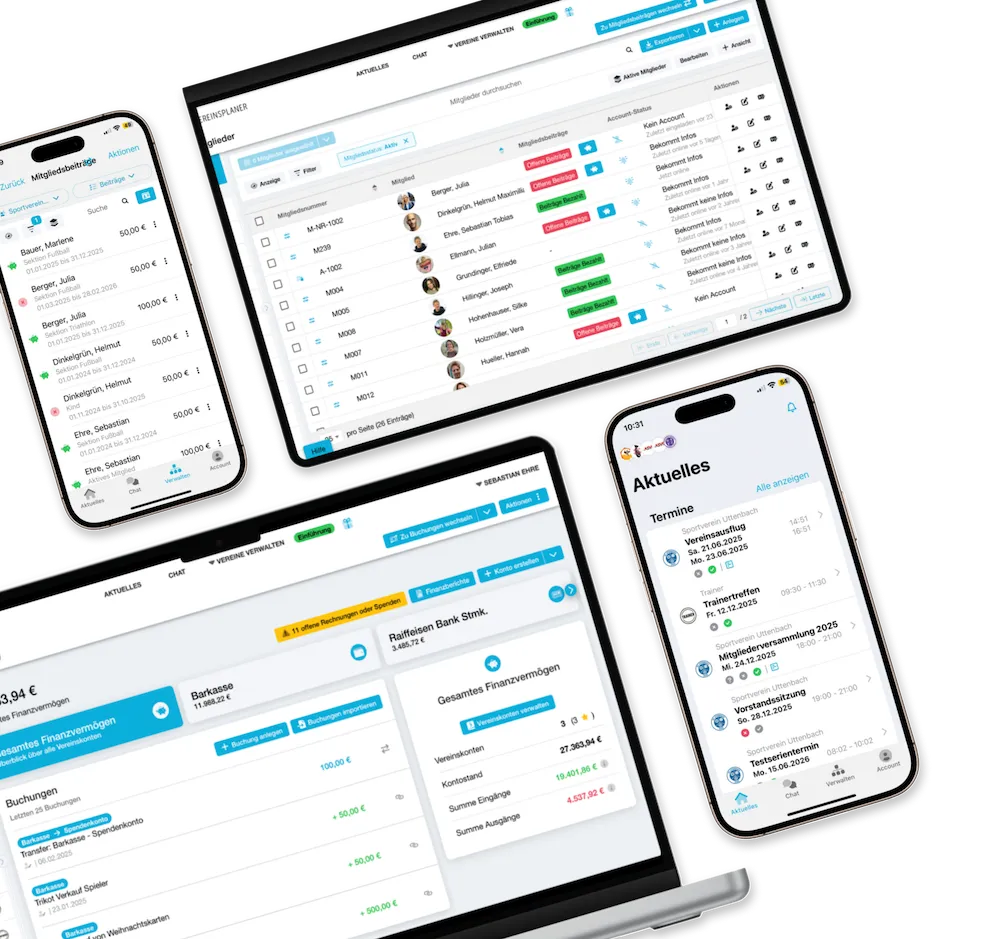
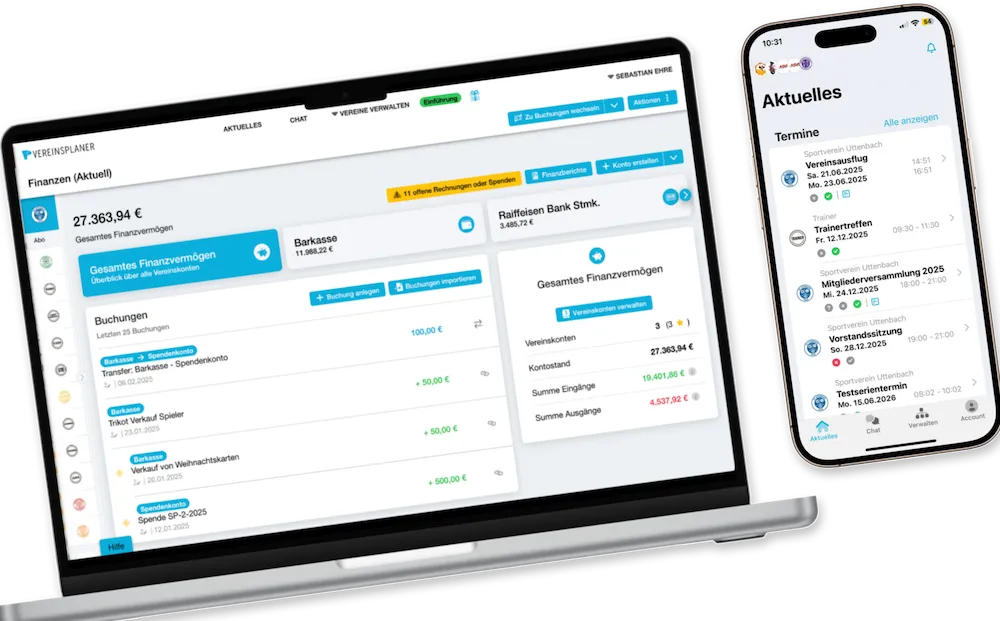
With Vereinsplaner, we aim to make financial management as simple as possible. Our financial tool, covering club accounting, invoicing & donation management, and one-click financial reports, significantly reduces administrative effort and errors. This allows you to focus primarily on your club's purpose and leadership. Learn more about financial management for clubs.
Secure your mega discount now with the code VP50DACH.VP30DACH.
In this short webinar, we'll show you how to efficiently manage contributions and keep track of your club's finances without stress – from start to finish.
In addition to traditional revenue streams like membership fees and donations, clubs can generate additional funds through creative fundraising strategies. This can include organizing events, crowdfunding campaigns, partnerships with local businesses, or selling merchandise.
Creating and providing regular financial reports is crucial for offering transparency to club members, donors, and other stakeholders regarding the club's financial situation. These reports should be clear, understandable, and comprehensive to strengthen stakeholder trust.
Clubs should be aware of the financial risks they face and take appropriate measures to minimize them. This includes building reserves for unforeseen expenses, insuring against risks such as liability claims, and diversifying revenue streams.
Clubs must strictly adhere to the applicable legal requirements in financial management to avoid fines, liability risks, and other legal issues. This includes proper accounting, compliance with tax regulations, and fulfilling other statutory obligations.
It is important that club members, especially those responsible for financial management, have sufficient financial literacy. Through training, workshops, and resources, they can improve their knowledge and skills in accounting and budgeting to ensure effective financial management.
Together with nine experts from practice, we have written a 98-page ePaper on current topics relating to clubs. The ePaper contains 5 chapters and 15 topics on important areas relating to the organization, members, funding, sponsors, taxes and more. You can download the handbook as a free download from the club handbook website.

Effective budgeting and accounting are crucial for the long-term success of your club. By carefully planning and monitoring your finances, you can ensure financial stability, minimize financial risks, and successfully advance your mission. Use the tips mentioned above to optimize your financial management and set your club on a solid financial course.
Please note that this article is intended as initial information on the topic mentioned. It neither claims to be exhaustive nor does it assume liability for the accuracy of the information. This article cannot in any way replace professional legal advice, and anyone seriously dealing with the topic of finances in a club should consult a legal expert at the appropriate time.