

The administration app for clubs, groups, teams, and associations.
Get started now

.webp)


This article provides an overview of the features and application areas of the income and expenditure statement (EAR) and the income surplus statement (EÜR), and supports associations in applying this accounting method.

The expanded application of Cash Basis Accounting (EAR) is a simplified method of profit determinationmethod of profit determination that is particularly used by clubs and non-profit organizations in Austriain Austria. In contrast to double-entry bookkeeping, with EAR, only income and expenses are recorded according to the cash basis principlecash basis principle, thereby simplifying the determination of profit or loss.The expanded application of Cash Basis Accounting (EAR) is a simplified that is particularly used by associations and non-profit organizations . In contrast to double-entry bookkeeping, with EAR, only income and expenses are recorded according to the , thereby simplifying the determination of profit or loss.
Cash Basis Accounting (EÜR) is the German term for EAR. It is also the simplified method of profit determination used by german clubs. Here, too, only income and expenses are compared to determine profit or loss. However, its application is more limited in Germany than in Austria.Cash Basis Accounting (EÜR) is the German term for EAR. It is also the simplified method of profit determination used by . Here, too, only income and expenses are compared to determine profit or loss. However, its application is more limited in Germany than in Austria.
Cash basis accounting is particularly suitable for clubs with limited resources and a simple accounting structure. It allows clubs to quickly ascertain their financial results, enabling them to plan effectively and position themselves financially.
When applying cash basis accounting in clubs, all income and expenses are recorded, regardless of their origin or purpose. This includes, for example, membership fees, donations, expenses for events, and administrative costs. The simple structure of cash basis accounting allows clubs to clearly present their financial situation and transparently determine their profit.
Some clubs utilize the advanced application of cash basis accounting (EAR/EÜR) to consider not only income and expenses but also changes in assets and certain reserves. This allows for a more accurate determination of profit and better planning of financial resources for future projects and expenditures.
Stay on top of your finances with financial management
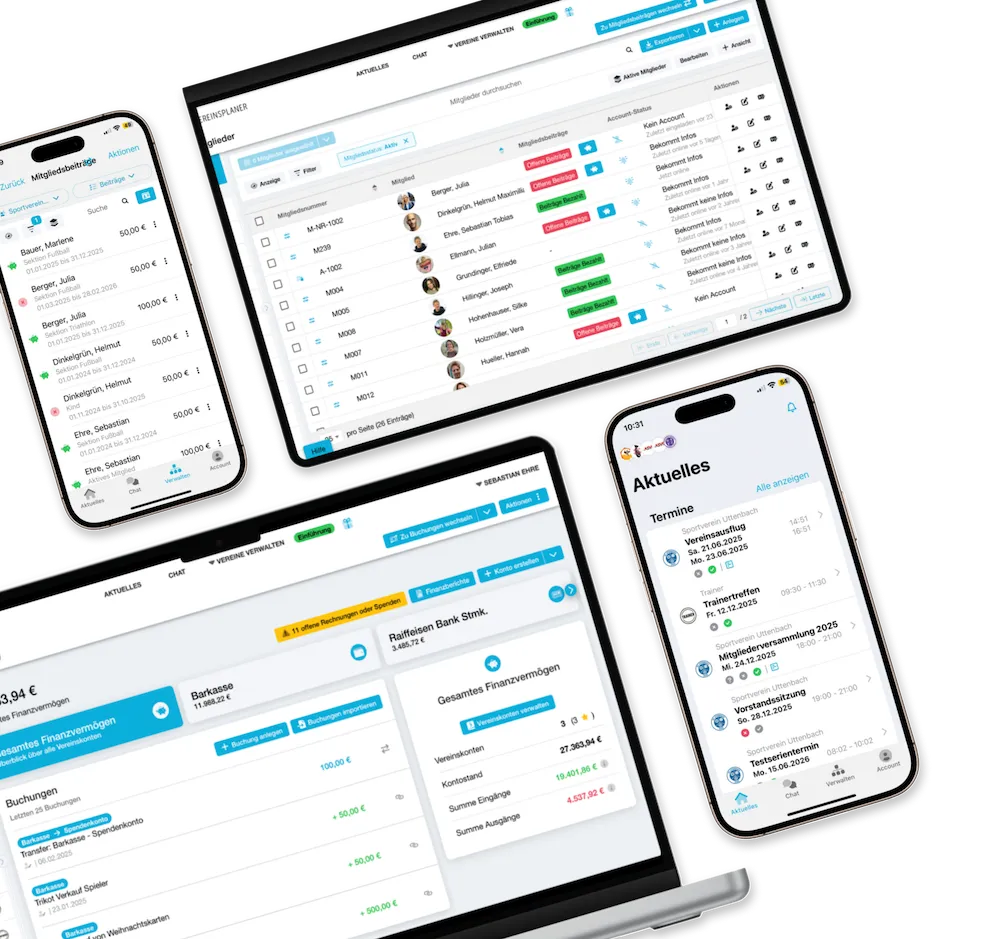
With Vereinsplaner, we aim to make financial management as simple as possible. This financial tool, covering club accounting, invoicing & donation management, and one-click financial reports, significantly reduces administrative effort and errors. This allows you to focus primarily on your club's mission and leadership. Learn more about financial management for clubs.
Join over 15,000 clubs
In this short webinar, we'll show you how to efficiently manage contributions and keep track of your club's finances without stress – from start to finish.

Secure your mega discount now with the code VP50DACH.VP30DACH.
In this section, we would like to present some case studies of clubs that use the Income-Expense Statement (EAR) and the Income Surplus Statement (EÜR). These case studies provide insights into the real-world experiences, challenges, and successes of clubs with different accounting methods. This aims to help you decide whether to choose EAR/EÜR.
The environmental club is a small non-profit organization dedicated to environmental protection projects. Since the club consists mainly of volunteers and generates only low income from donations and grants, it has opted for the simple accounting method of EAR/EÜR.
Through EAR, Club X can easily and straightforwardly record its financial transactions. The board members have no special accounting training, but they can still easily track income and expenses and keep an eye on the club's financial situation.
In this example, we have a medium-sized sports club that offers various programs and activities for its members. Since the club has a wide range of income sources, including membership fees, donations, events, and sponsorships, it has opted for the slightly more comprehensive accounting method of EÜR.
Through EÜR, the club can track and analyze its income and expenses in more detail. The accounting is managed by a professional accountant who is able to record complex transactions and generate comprehensive financial reports.
Adhering to compliance and legal requirements is crucial for club accounting to avoid fines, liability risks, and other legal issues. Here are some key aspects that clubs should consider:
Clubs should familiarize themselves with the legal provisions and regulations that apply to their accounting. These include, among others, association law, tax law, non-profit law, and commercial law.
Clubs are legally required to maintain proper accounting records. This means that all financial transactions must be recorded accurately and completely. This includes income from membership fees, donations, grants, events, and other sources, as well as expenses for operating costs, projects, and programs.
Clubs must comply with legal deadlines for submitting financial reports, tax returns, and other documents. Failure to do so can lead to legal consequences, including fines and penalties.
Clubs should provide their members, donors, and other stakeholders with transparent and comprehensive financial reports. These reports should be clear and understandable, offering an overview of the club's financial situation, as well as its income and expenses.
Depending on the size and legal structure of the club, audit requirements may apply. In some cases, an annual external audit by a chartered accountant or an internal review is necessary to confirm the proper conduct of the accounting.
When handling accounting and managing member data, clubs must comply with applicable data protection laws. This means that personal data must be treated securely and confidentially and may only be used for legitimate purposes.
Clubs should identify risks associated with their financial management and take appropriate measures to minimize them. This includes building reserves, securing against liability claims, and implementing internal controls and procedures.
Please note that this article is intended as initial information on the topic mentioned. It neither claims to be exhaustive nor does it assume liability for the accuracy of the information. This article cannot in any way replace professional legal advice, and anyone seriously dealing with the topic of finances in a club should consult a legal expert at the appropriate time.
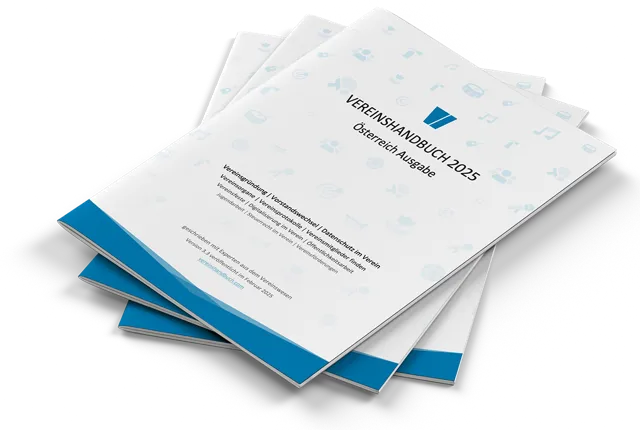
Together with nine experts from practice, we have written a 98-page ePaper on current topics relating to clubs. The ePaper contains 5 chapters and 15 topics on important areas relating to the organization, members, funding, sponsors, taxes and more. You can download the handbook as a free download from the club handbook website.
Here you will find answers to frequently asked questions about income-expenditure accounting for clubs.
Income and expenses are only recorded at the moment the money is actually received or debited from the club's account. The time of invoicing or service provision is irrelevant.
Income-Expenditure Accounting (EAR) is a method of profit determination in Austria based on the cash basis principle. Income Surplus Accounting (EÜR) is the corresponding method for German clubs.
A complete EAR consists of a continuously maintained cash book (or bank book), the corresponding organized receipts, and an asset register for durable club assets.
The software automates data entry through digital cash books, links receipts directly to transactions, and generates financial reports with a click of a mouse. This saves the club board a lot of time and ensures tax-compliant documentation.