

The administration app for clubs, groups, teams, and associations.
Get started now

.webp)


The club protocol is a central tool for documenting important decisions and discussions in club life. Even though there are few to no legal requirements for this, it is important to consider a few points in order to prevent problems that arise later and to store information.
Let me preface one thing: You don't have any legal obligation, a club protocol for your general meeting and the like — even if it is possible that the obligation to do so has been laid down in the association's statutes.
However, there are a few good reasons for logging and recording information from your meetings. Here are three of the most important:
It may be useful to enshrine the drafting of minutes of board meetings and various meetings in the statutes so that the respective responsible members are required to do so from the club's point of view. This also helps to verify whether the resolutions based on the club's statutes are valid.
If you want to be on the safe side of the law, then we recommend our legal documents with 10 prepared statutory proposals on members' meetings.

Even though some of the club's protocol may be individually structured, it should definitely contain certain information so that it actually fulfills the above-mentioned purposes. You should definitely include the following data sets in the log:
So that you can understand the contents of the meeting in the medium and long term, the following information should also be included:
Even though some of the club's protocol may be individually structured, it should definitely contain certain information so that it actually fulfills the above-mentioned purposes. You should definitely include the following data sets in the log:

Join over 15,000 clubs
A well-kept set of minutes records the resolutions and key discussions of the general meeting. Our checklist helps you prepare for the meeting and document essential outcomes in a clear, traceable way.

A distinction is made between three different types of protocols: result log, history log and word log. Which type you choose depends on the complexity of the topics set out in the agenda.
If the issues and decisions are complicated, extensive and complex, it is worthwhile to record in detail — this is also recommended for financial matters and decisions with long-term consequences. In general, it is better to document a little too much than to document too little.
Depending on this, however, it certainly also offers to mix the shapes. But how do the three forms mentioned differ anyway?
As the name suggests: The results report focuses on the result. Individual contributions to the discussion are not logged; the document contains (almost) exclusively resolutions and decisions. A very simple result log could look like this:
Here it is not necessary to keep a detailed record of the details of the decision. For more complex topics, this form of logging would not be enough.
The history log also contains compressed contributions. It is not necessary for the members to be quoted precisely — but their views should be clear from the minutes. We recommend this type of recording especially for board meetings.
In fact, every word spoken is documented in the word log. This is only recommended in exceptional cases, as this requires an experienced and quick secretary. Fortunately, there are only rarely cases in board work where the word minutes are required — but it can be useful to quote individual contributions to the discussion word for word. And this form of protocol can also be kept as a supplement. However, please clarify this with all parties involved beforehand.
Secure your mega discount now with the code VP50DACH.VP30DACH.
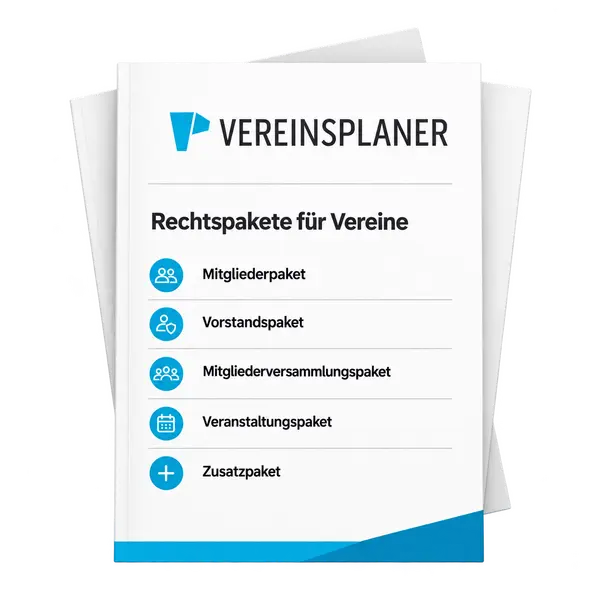
With our two general meeting templates, you can clearly record resolutions, votes, and election results. Choose between a general template and a more detailed version with pre-defined agenda items. Both are part of the general meeting package from the Vereinsplaner legal packages.
As already mentioned in more detail, a protocol has a clear goal. Ideally, it records and documents all the results of meetings, meetings, negotiations and many other (critical) discussions. In addition, the information in the minutes is used to store and transmit decisions to the members and the Executive Board.
In practice, a protocol is therefore nothing more than evidence in the event of a dispute and in the event of any challenges to decisions. Ideally, the minutes only serve as a reminder of past appointments and meetings in order to quickly get back to old points and not waste any time.
A little tip: In any case, the protocol should be kept by someone who can both listen and document at the same time and is also not biased in making decisions. The notes on meetings should definitely be written out the same evening or the next day in the morning and sent to the other participants. In this way, nothing “important” is forgotten or misinterpreted.
Where we with Vereinsplaner can provide automated support and supplement protocols are evaluations of meetings (admissions and cancellations and (anonymous) elections) as well as central data storage of logs and documents in online storage. Feel free to take a look at the range of functions and benefit from ideal club management.

In order to optimally support you with your protocol, we have prepared a sample template with all important points as a Word document for you. You can obtain this in the legal area of the Vereinsplaner. The protocol is a guide as to what content should be and can be tailored to your needs at will.
Attention! Not every member of the club will always interpret the content of a meeting in the same way — often even resolutions are perceived completely differently. A member could then attempt to challenge the meeting minutes. It is therefore important to specify in the statute who can appeal against the minutes and how this should be done. If there is no such regulation, every participant in the meeting can raise their objection completely informally.
Important detail: If a meeting minutes is contested at the subsequent meeting, the respective chairman of the meeting must absolutely investigate this objection. If the objection is justified, the minutes must be amended — by means of an entry in the minutes of the current meeting.
In simple terms, this means that the minutes of the last meeting are read out for each agenda item. One of the members objects to a point in the minutes. If this is in fact correct, the minutes must be amended.
An appeal is also possible if a member feels attacked by the protocol. For example, if a heated discussion took place and someone was mentioned by name, with the reference that they behaved abusively, that person can dispute the entry. If these are not factual findings but insults or subjective feelings, then the entry must be amended.
It is not common for the entire minutes of the previous meeting to be read aloud everywhere. It is often sent with the invitation to the upcoming meeting. Each member specified in the statutes then has the opportunity to file an objection. This can be done by telephone, in person, via email or even by letter or even via fax if the form is not specified in the statutes.
There is no time limit for this — although you should of course encourage the club members to file possible appeals within a few days so that there is no major additional organizational effort.
Learning from this chapter
Determine the members who may lodge an objection, as well as the form and provisions relating to time limits, in the statutes. In case of doubt, this saves you a lot of work and discussion.
Together with nine experts from practice, we have written a 98-page ePaper on current topics relating to associations. The ePaper contains 5 chapters and 15 topics on important areas relating to the organization, members, funding, sponsors, taxes and more. You can download the handbook as a free download from the association handbook website.

Here you can find answers to frequently asked questions about the club protocol.
It is not legally mandatory for clubs to keep records, but the obligation to do so may be specified in the club's statutes. Whether mandatory or not, logging has significant advantages in terms of the traceability of decisions.
Who must sign the minutes is defined in the club's statutes. If the question cannot be resolved on the basis of the statutes, the chairman of the meeting and the secretary must sign it.
There are 3 types of protocols: resolution log, history log and word log. The decision as to which type to choose depends on the complexity of the topics discussed.
An association protocol must contain 3 things so that the board can comply with the notification obligation to the members: -
In addition, there are some important details that a club should or can include in the minutes:
A club protocol is always suitable when important topics are discussed and important decisions are made. The most common use cases are general meetings and board meetings.